
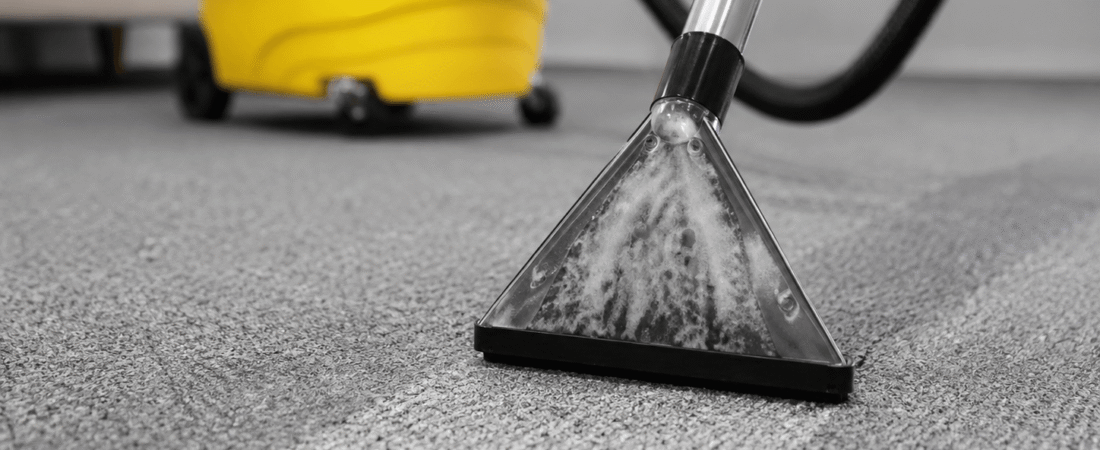
If your carpet smells after cleaning, something went wrong — and it is almost never the cleaning solution. A carpet that smells worse than before it was cleaned is telling you one of two things: moisture stayed in it too long, or something was already living in the backing and the cleaning woke it up without taking it out.
Both are fixable. But they need opposite responses, and doing the wrong one makes it worse. Here is how to tell which one you have.
Short answer: carpet smells after cleaning when too much water went in and not enough came back out. Slow drying lets bacteria grow in the backing and pad, producing a sour, musty odour. The other common cause is old pet urine that was rewetted and reactivated but never fully removed.
What’s in this guide
- Identify it by the smell
- Cause 1: it stayed wet too long
- Cause 2: old pet urine woke up
- Cause 3: detergent left in the fibre
- Cause 4: the smell was never in the carpet
- What to do in the first 24 hours
- Why Georgia makes this worse
- When the pad has to come out
- How this gets avoided
- Frequently asked questions
Identify it by the smell
The smell itself tells you the cause. Before doing anything, get close to the carpet and be specific about what you are smelling.
| What it smells like | Almost certainly | Urgency |
|---|---|---|
| Sour, musty, wet dog, wet towel | Microbial growth from slow drying | High — acts within days |
| Sharp ammonia, worse in humidity | Old pet urine reactivated | High |
| Sweet, chemical, perfumed | Detergent residue left in the fibre | Low — annoying, not damaging |
| Earthy or mildew, strongest near walls | Sub-floor, pad or something outside the carpet | Investigate |
One useful test: does it get stronger when the room warms up or humidity rises? Both microbial growth and urine intensify with heat and moisture. Detergent residue does not.
Cause 1: it stayed wet too long
This is the most common one by a wide margin.
Carpet is not one layer. There is the face fibre you see, a backing, then the pad underneath. Water that reaches the pad has almost nowhere to go — it cannot evaporate through the carpet quickly and there is no airflow beneath it. Bacteria in a dark, damp, warm space multiply fast, and the by-product of that is the sour smell you are describing.
It comes down to a ratio nobody talks about: how much water went in versus how much came back out. Every cleaning method puts water down. What separates them is vacuum recovery. A machine with strong recovery pulls most of it back; a rental machine recovers a fraction, and the rest stays in the backing and pad.
That is why the same carpet, cleaned with the same solution, can be fine one time and sour the next. The variable is not the chemistry. It is extraction.
The timeline that matters: up to about 24 hours of dampness, you are fine. Past 24 hours, microbial growth establishes. Past 48, it is no longer a drying problem — more air will not fix it, and it needs treatment.
Cause 2: old pet urine woke up
This one catches people who did not even know they had a urine problem.
When a pet accident dries, it does not disappear. It leaves crystallised salts in the fibre, the backing and often the pad. Dry, those crystals are relatively odourless — which is why a house can smell fine for months.
Add moisture and the crystals dissolve back into solution, and the smell returns at full strength. Any cleaning adds moisture. So a carpet cleaned with a surface method can come out visually cleaner and smelling dramatically worse, because the cleaning rehydrated contamination that a surface method cannot reach.
The give-away is location. Microbial odour from slow drying is diffuse — the whole room. Urine odour is concentrated in patches, often near doors, edges of the room, or a favourite corner, and it is sharper and more ammonia-like.
Surface cleaning cannot solve this because the contamination is not on the surface. It needs the source broken down where it actually sits, which is what enzyme treatment does — the approach behind our pet stain and odour service. Masking it with deodoriser buys a few days and then it comes back, usually on the first humid afternoon.
Cause 3: detergent left in the fibre
Less serious, but worth naming because the fix is different.
Cleaning solution that is not rinsed out stays in the carpet. It is sticky, so it attracts soil and the carpet re-soils quickly — and as it degrades, some detergents produce a stale, sweetish smell of their own.
This is the signature problem of rental machines and of over-application. The detergent goes down easily; getting it back out is the hard part, and weak recovery cannot.
The fix is a proper rinse, not more product and not a deodoriser. Adding fragrance on top of residue gives you both smells at once.
Cause 4: the smell was never in the carpet
Sometimes carpet cleaning does not cause a smell — it reveals one.
Carpet holds odour. Remove the accumulated smell of daily life and other sources become noticeable for the first time. Common ones:
- Crawl space or sub-floor moisture, especially in older Cobb County homes on a crawl space
- HVAC returns that need a filter change — usually stronger when the system kicks on
- A previous spill in the pad from before you lived there
- Damp inside a wall from a slow plumbing leak — smell concentrated along one wall is the tell
The test is simple: if the smell does not fade as the carpet dries, it is probably not the carpet. Microbial and urine odours change as moisture changes. A source outside the carpet stays constant.
What to do in the first 24 hours
If your carpet is still damp and starting to smell, this window matters. Act now and it usually resolves without treatment.
- Get air moving across the carpet — fans at floor level, aimed sideways rather than down. Ceiling fans on.
- Run the air conditioning. Not the windows, in Georgia weather. Your AC is a dehumidifier that also cools.
- Keep the house closed while the AC runs. Opening up on a humid day imports the problem.
- Lift anything sitting on the carpet. Rugs, boxes, furniture — anything blocking airflow stays wet underneath and that is where the smell starts.
- Do not add deodoriser, powder or fragrance. It masks the signal you need, and carpet powders are difficult to fully remove afterwards.
- Do not re-clean it. More water on an already over-wet carpet makes it worse, every time.
If it is dry and still smells, drying is no longer the issue and you have moved into treatment territory.
Why Georgia makes this worse
Cobb County summers regularly sit above 70% relative humidity, and air already holding that much moisture cannot absorb much more. The same job that dries without incident in February can sit damp for an extra day in August — and that extra day is exactly the difference between fine and sour.
This is why the instinct to open the windows backfires here for months of the year. It is also why extraction quality matters more in this climate than in a dry one: when the weather will not help you dry, how much water came out at the time of cleaning becomes the whole game. We go into that in how long carpet takes to dry.
When the pad has to come out
Sometimes cleaning is not the answer, and an honest cleaner will tell you so.
Replace the pad when:
- Urine has saturated through to the pad repeatedly in the same area — the pad is a sponge and holds far more than the carpet above it
- The carpet has been damp for several days and the smell persists after full drying and treatment
- Pulling back a corner reveals staining on the pad or sub-floor — that is contamination the face cannot reach
- The smell returns within days after successful treatment, repeatedly
The carpet itself can usually be saved. The pad is inexpensive compared with replacing carpet, and treating a pad that is beyond saving is money spent twice.
How this gets avoided
Every cause on this page traces back to the same two things: how much water came back out, and whether the contamination was actually removed instead of just rewetted.
In practice that means checking for urine before cleaning rather than discovering it afterwards, matching the method to the carpet instead of using one setting for everything, rinsing detergent back out rather than leaving it, and setting up airflow before leaving the house instead of hoping for the best.
None of that is exotic. It is the difference between a job that is finished when the machine turns off and one that is finished when the carpet is dry. Our carpet cleaning is built around the second definition.
Frequently asked questions
Will the smell go away on its own?
If it is caused by dampness and the carpet dries fully within about 24 hours, usually yes. If the carpet is dry and still smells, it will not resolve by itself — that means microbial growth or urine contamination that needs treatment.
Why does my carpet smell like a wet dog after cleaning?
That specific smell is bacteria in the damp backing and pad. It means too much water went in, too little came out, or there was not enough airflow afterwards. Get air moving immediately and run the AC.
Can I just use a carpet deodoriser?
It masks the smell for a few days and comes back, usually worse in humid weather. Powders are also hard to fully vacuum out of the pile and can add to the residue problem. Treat the cause instead.
Why did the pet smell get worse after cleaning?
Dried urine crystals are nearly odourless until they get wet. Cleaning rehydrated them and released the smell at full strength. It means the contamination was reactivated but not removed — it needs enzyme treatment at the depth it actually sits.
How soon should I call someone?
If the carpet is still damp after 24 hours, or dry and still smelling, call rather than waiting. Past 48 hours, drying alone stops fixing it. Call 470-590-5768 and describe the smell — that usually tells us the cause before we arrive.
Carpet smelling worse than before it was cleaned?
Tell us what it smells like and how long it stayed damp — that usually identifies the cause over the phone. We fix other people’s jobs regularly and will tell you straight if the pad needs replacing instead. Free estimates across Marietta and Cobb County.