
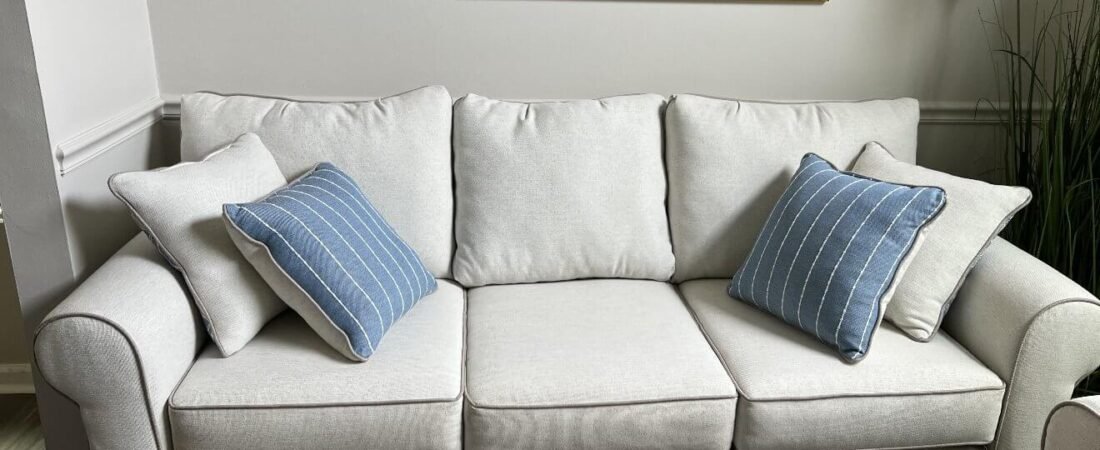
Learning how to clean a microfiber couch is mostly about learning what not to do. Microfiber is the most common upholstery fabric in Marietta homes and the easiest one to ruin with good intentions. Most of the damage we get called to fix was caused by someone with a spray bottle and a bath towel, not by the original spill.
This guide covers the method that works, the fabric code that decides which liquid you are allowed to use, and the point where stopping saves you money.
Short answer: vacuum thoroughly, check the tag for a cleaning code, then work in small sections with either rubbing alcohol (code S) or a mild soap solution (code W). Blot, never scrub. Dry the whole panel evenly with a fan and brush the nap back in one direction. Uneven drying is what causes water rings, not the water itself.
What’s in this guide
Why microfiber shows water rings so easily
Microfiber is not one material. It is a dense weave of extremely fine synthetic strands, and the fineness is the whole point — it feels soft because there are more fibres per square inch than in a conventional fabric.
That density is also the problem. When you wet one patch and leave the rest dry, the water travels outward through the weave by capillary action, carrying dissolved soil with it. It stops where it finally evaporates, and it deposits that soil in a line. That line is the ring. You are not looking at a water stain. You are looking at the dirt from the middle of the wet patch, concentrated at its edge.
This is why the professional rule is counterintuitive: the fix for water rings is not less water. It is even water and even drying across the whole panel.
Find the cleaning code first — W, S, WS or X
Before anything touches the fabric, find the tag. It is usually under a cushion, on the deck of the frame, or stitched under the skirt. There will be a letter, and it is not a suggestion.
| Code | Means | Use |
|---|---|---|
| W | Water-based cleaning is safe | Mild soap and distilled water |
| S | Solvent only — water will stain it | Rubbing alcohol, 70% or higher |
| WS | Either one works | Start with alcohol, it dries faster |
| X | Vacuum only | Nothing wet. At all. Call a professional |
No tag? Test in a hidden place — the back of the skirt, or the underside of a cushion. Dab a little distilled water on a white cloth, press it to the fabric for ten seconds, and let it dry completely. If a mark appears, treat the couch as code S.
Use a white cloth for every test and every wipe. A coloured towel can transfer its own dye into damp microfiber, and that is a stain no cleaning removes.
What you need
- A vacuum with an upholstery attachment and a crevice tool
- Several clean white microfiber cloths — more than you think
- Rubbing alcohol in a spray bottle (code S or WS), or mild dish soap and distilled water (code W)
- A soft-bristle brush — a clean nail brush works
- A box fan or two
Distilled water matters more than it sounds. Marietta tap water carries minerals, and those minerals dry into the fibre as a faint pale haze. On a dark couch you will see it.
Step by step, without the rings
1. Vacuum properly, not quickly
Take the cushions off. Vacuum both faces of each cushion, the deck underneath, and every seam with the crevice tool. Grit in the weave turns to mud the moment it gets wet, so this step decides how the rest goes.
2. Work one panel at a time
A panel is a whole seam-to-seam area: one cushion face, one arm, one back section. Never clean half a panel. The seam is what hides the transition, and stopping in open fabric is how you create a visible edge.
3. Mist, do not soak
Spray lightly and evenly until the surface is barely damp. It should never feel wet to the touch. If you can see droplets sitting on the fibre, you have used too much.
4. Blot, never scrub
Press a white cloth into the fabric and lift. Rotate to a clean part of the cloth and repeat. Scrubbing distorts the nap and creates a permanent shiny patch that reads as a stain from across the room.
5. Dry the whole panel evenly
Point a fan at the panel and leave it. Do not let one half dry faster than the other — that is exactly how the ring forms. Two to four hours is normal.
6. Brush the nap in one direction
Once it is fully dry, run the soft brush across the panel in a single consistent direction. This is the step almost everyone skips, and it is what makes the difference between clean and uniform. Microfiber that dried in different directions looks blotchy even when it is perfectly clean.
The five mistakes that cause permanent damage
- Cleaning a spot instead of a panel. The number one cause of rings. A clean circle on a dirty couch looks worse than the original spill.
- Coloured or printed cloths. Dye transfer into damp microfiber is permanent.
- Scrubbing. Flattens the nap and creates a shiny patch that no cleaning reverses.
- Water on a code S fabric. The tag exists for a reason. Water genuinely stains solvent-only microfiber.
- Steam from a garment steamer. Heat can shrink or glaze synthetic fibre, and the moisture goes straight into the foam where you cannot extract it. This is where DIY causes the mildew smell people call us about a week later.
How to fix a water ring you already made
Often you can. The trick is counterintuitive: you have to re-wet the whole panel, not the ring.
Lightly and evenly mist the entire panel with the correct liquid for your code, blot it uniformly, then dry it all at once with a fan. You are dissolving the concentrated soil line and redistributing it so it dries evenly instead of pooling at one edge. Finish by brushing the nap in one direction.
If the ring survives two even attempts, the soil has bonded to the fibre and it needs extraction rather than surface cleaning. Stop before you make it worse.
When DIY stops working
Home cleaning reaches the surface. It does not reach the foam, and on a couch the foam is where the actual problem lives — body oils, pet dander, spilled milk from two years ago. That is a job for hot water extraction with tight moisture control.
Call a professional when:
- The couch smells but looks clean — odour is in the padding, and no surface cleaner reaches it
- The arms and headrest are visibly darker than the back — that is accumulated body oil, and it needs pre-treatment with dwell time
- A pet has had an accident on it — urine needs enzyme treatment at the padding level, not deodoriser on top
- The tag says X
- You have tried twice and it is getting worse
Sable & Steam cleans sofas and sectionals and upholstery of every fabric in homes across Marietta, and we test colourfastness in a hidden spot before anything touches the visible fabric — every time. If a piece is not safe to wet clean, we tell you before starting instead of afterward.
Frequently asked questions
Can I use rubbing alcohol on any microfiber couch?
On code S and WS fabrics, yes, and it is the better choice because it evaporates fast and leaves no mineral residue. On code W it is unnecessary. On code X, nothing wet should touch the fabric at all.
Why did my microfiber couch get stiff after cleaning?
Almost always soap residue. Dish soap that was not fully blotted out dries in the weave and stiffens it. Re-clean the panel with plain distilled water, blot thoroughly, dry evenly, then brush the nap.
How long does a microfiber couch take to dry?
Two to four hours with a fan running. Alcohol-based cleaning is faster, often under an hour. Do not sit on it while damp — body weight on wet microfiber crushes the nap unevenly.
Will a steam cleaner work on microfiber?
We do not recommend a consumer steamer. Heat can glaze or shrink synthetic fibre, and the moisture reaches the foam where you have no way to extract it. Professional extraction uses controlled moisture and pulls the water back out, which is a different process entirely.
How much does it cost to have a microfiber couch professionally cleaned?
It depends on size, fabric condition and whether there is pet contamination. We quote from a photo before we arrive, and the number we give you is the number you pay. Call 470-590-5768 for a free estimate.
Cleaned it twice and it still looks patchy?
Send us a photo and we will tell you honestly whether it needs extraction or whether one more even pass will do it. Free estimates across Marietta, Smyrna, Vinings and East Cobb — open 24 hours.