
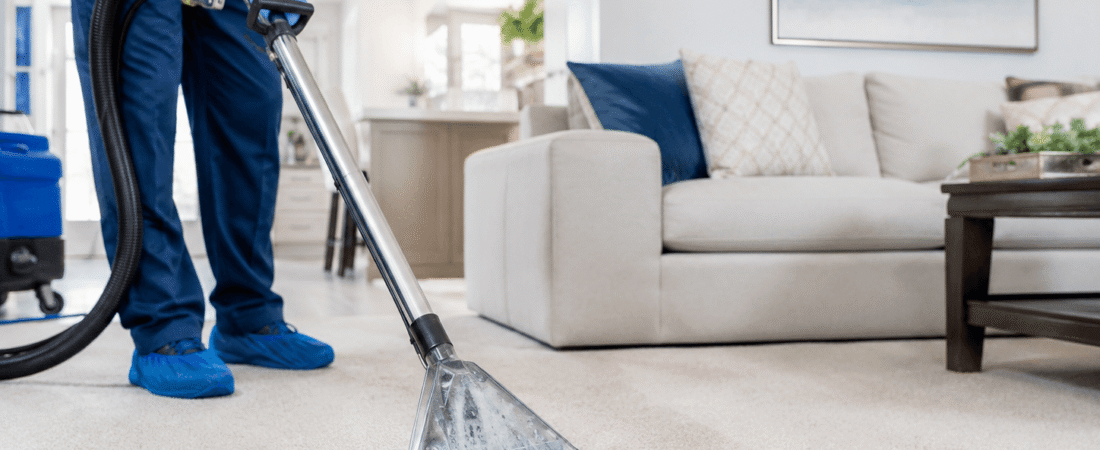
How often carpet should be professionally cleaned is usually answered with a number that has nothing to do with your house — “once a year” gets repeated because it is easy to say, not because it fits a two-dog household in Marietta any better than it fits a retired couple who take their shoes off at the door.
There is a real answer, it depends on about six things, and there is one reason to stay on schedule that most homeowners never hear about: your carpet warranty probably requires it.
Short answer: most homes need professional carpet cleaning every 12 to 18 months. With pets, children or allergies, every 6 to 12 months. Rentals and offices run every 3 to 6 months. Check your warranty — most carpet manufacturers require documented professional cleaning at set intervals to keep it valid.
What’s in this guide
The schedule, by household
| Situation | Professional cleaning |
|---|---|
| Single adult or couple, no pets, shoes off | Every 18 months |
| Average family home | Every 12 – 18 months |
| One pet | Every 12 months |
| Multiple pets, or a pet that has accidents | Every 6 – 9 months |
| Young children, crawling age | Every 6 – 12 months |
| Allergy or asthma in the household | Every 6 months |
| Smokers indoors | Every 6 months |
| Rental property | Every turnover |
| Office and commercial | Every 3 – 6 months, traffic lanes more often |
| Assisted living and care facilities | Quarterly, with spot response between |
Find the row that describes you honestly rather than the one you would prefer. A household with two dogs and a toddler is not an “average family home,” and treating it like one is how carpet gets replaced years early.
The warranty clause nobody reads
This is the part that changes the conversation, and almost nobody knows it.
Most major carpet manufacturers require professional cleaning at a set interval as a condition of the warranty — typically every 12 to 24 months, using hot water extraction, performed by a qualified professional. Not a rental machine. Not a DIY afternoon.
They also require you to keep the receipts. When a warranty claim is filed for texture retention, matting or premature wear, proof of scheduled professional cleaning is one of the first things asked for. No documentation, no claim.
The exact interval and method vary by brand and by product line, so read your own paperwork rather than trusting a general rule. But the pattern is consistent across the industry, and the outcome is the same: a homeowner who skipped cleaning to save money can lose a warranty worth far more than the cleanings would have cost.
Two practical points. Ask for an itemised receipt showing the method used and the date — we provide that as standard. And if your carpet is under ten years old, dig the warranty out of the drawer before deciding your interval; the paperwork may have already decided it for you.
What actually changes your interval
Foot traffic and shoes
The single biggest factor. A shoes-off household can genuinely run 18 months on the same carpet that needs 9 in a shoes-on household. Outdoor shoes carry grit, oil and asphalt sealant straight into the fibre.
Pets
Dander, oil from coats, and outdoor soil on paws — constantly, in the areas they sleep. Accidents move you into a different category entirely, because urine in the pad is a contamination problem rather than a soil problem.
Children
Crawling children spend their day with their face at carpet level. That alone moves most parents to a shorter interval, independent of visible dirt.
Allergies and asthma
Carpet is a filter. It traps pollen, dust mite allergen and dander — which is genuinely useful, right up until the filter is full. A full filter releases its contents back into the air every time someone walks across it.
Carpet colour and fibre
Light carpet shows soil sooner but is not dirtier. Berber and low loop hide soil well, which is a trap — they look acceptable long past the point where grit is doing damage. Wool holds far more dry soil than synthetic before it looks dirty.
Whether the house is a rental
Turnover cleaning is not about appearance, it is about documentation. A cleaning receipt at move-out settles deposit arguments before they start, for tenant and landlord alike.
Why Georgia is harder on carpet
Two local factors shorten intervals here compared with most of the country.
Red clay. Georgia clay is fine, it is iron-rich, and it is a dye. Once it works into carpet fibre it behaves less like soil and more like a stain — and the longer it stays, the more it sets. Homes with a clay driveway, ongoing construction nearby, or a dog with a favourite patch of yard are on a shorter clock than the table above suggests.
Pollen season. Metro Atlanta runs some of the highest pollen counts in the country each spring, and it comes indoors on shoes, clothes and pets no matter how carefully you close the windows. For an allergy household, a cleaning scheduled for late spring, after the count drops, is worth more than the same cleaning done at any other time of year. Timing matters as much as frequency.
Summer humidity is the third factor, and it works differently — it does not add soil, it slows drying. That is a reason to care about extraction quality, which we cover in how long carpet takes to dry.
What waiting too long actually costs
The reason to stay on schedule is not appearance. It is that soil is abrasive.
Dry soil in carpet is largely mineral — sand, grit, clay. Under a microscope it is sharp. Every step grinds those particles against the fibre, and each pass takes a little of the fibre with it. The fibre gets scratched, then it gets fuzzy, then it stops reflecting light evenly. That is what “traffic lanes” actually are: damaged fibre, not dirty fibre.
Which is why the timing matters so much. Clean on schedule and you remove the abrasive before it does its work. Wait until the carpet looks bad and you are cleaning fibre that has already been permanently dulled — the soil comes out, and the traffic lane stays, because the damage was never dirt.
Put in money terms: carpet in a family home should last 10 to 15 years. Neglected, it looks worn out in 5 to 7. The cleanings you skipped cost a fraction of the replacement you brought forward by a decade.
Signs you are already overdue
- Traffic lanes visible in normal daylight, especially hallways and in front of seating
- The carpet feels crunchy or stiff underfoot — that is grit at the base of the pile
- A smell that returns a day or two after vacuuming, particularly in humid weather
- Allergy symptoms worse at home than elsewhere, or worse in the morning
- The vacuum keeps filling from an area you vacuum regularly
- Pile stays flat where furniture used to be, long after it was moved
- You cannot remember the last cleaning — the most reliable sign on the list
Can you clean carpet too often?
Not with correct method. Yes with the wrong one — and this is worth understanding before you decide more is better.
The risk is not water. It is detergent residue. Cleaning that leaves soap in the fibre creates a sticky film that attracts soil faster than before, so the carpet re-soils within weeks and each cycle leaves more behind. People in that loop conclude that “cleaning makes carpet get dirty faster,” and within their experience they are right.
That is a residue problem, not a frequency problem. Proper hot water extraction rinses the detergent back out, which is precisely what a rental machine cannot do — weak vacuum recovery leaves both water and soap behind.
Clean correctly and there is no upper limit that matters. Commercial floors are cleaned quarterly for decades without harm.
What to do between cleanings
What you do in the months between changes the interval more than the cleaning itself does.
- Vacuum slowly. Several passes at walking pace, twice a week in traffic areas. Speed is what makes vacuuming useless.
- Walk-off mats at every entry, inside and out. Most soil enters in the first few steps through the door.
- Shoes off if you can live with it. Nothing else on this list comes close.
- Blot spills immediately, straight down, never rubbing. Most permanent stains started as a spill somebody rubbed.
- Move furniture slightly now and then so wear does not concentrate in the same lanes.
- Ask about protector after cleaning. It buys you time to blot the next spill before it becomes a stain.
Frequently asked questions
How often should carpet be professionally cleaned with pets?
Every 6 to 12 months, depending on how many pets and whether there have been accidents. Dander and coat oil build up faster than most owners expect, and urine reaching the pad is a contamination problem that vacuuming cannot touch.
Does professional cleaning really keep my warranty valid?
For most major manufacturers, yes — documented professional cleaning at a set interval is a condition of coverage, and receipts are requested when a claim is filed. Intervals and accepted methods vary by brand, so check your own warranty paperwork.
Is once a year enough?
For an average household with no pets and moderate traffic, yes. Add pets, young children, allergies or indoor smoking and 12 months is too long. The table above is a better guide than any single number.
What is the best time of year to clean carpet in Georgia?
Late spring, after pollen season drops, is ideal for allergy households. Otherwise any time works — humidity affects drying time rather than cleaning quality, and running the AC handles that.
Does vacuuming replace professional cleaning?
No. Vacuuming removes loose surface soil and is essential between cleanings, but it cannot reach the grit packed at the base of the pile, and it does nothing about oils, allergens or anything already bonded to the fibre.
Not sure when your carpet was last cleaned?
That is usually the answer in itself. Tell us the rooms and we will price it over the phone — no in-home sales visit, and an itemised receipt for your warranty file. Free estimates across Marietta and Cobb County.