
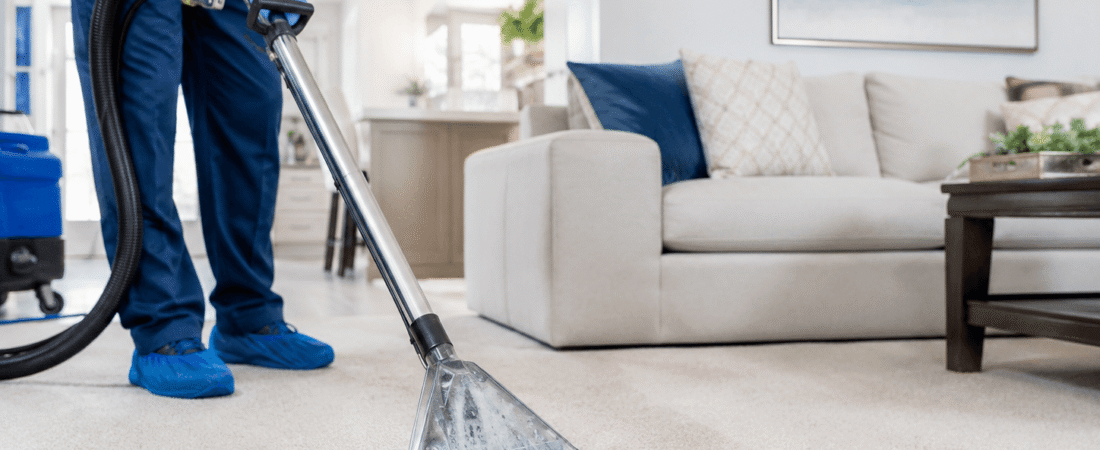
How long carpet takes to dry after cleaning is the question we get asked most often on the phone — usually by someone who needs the living room back before guests arrive. The honest answer depends on the method, the fibre and the weather, and anyone who gives you a single number without asking what carpet you have is guessing.
Here are the real ranges, what moves them, and why the fastest dry time is not automatically the better clean.
Short answer: carpet cleaned with hot water extraction is typically dry in 8 to 18 hours. Heavily soiled carpet sits at the top of that range, because it needs more pre-spray and more passes. Low-moisture methods take 1 to 3 hours. A rental machine can stay damp 24 hours or more.
What’s in this guide
Dry times by method
| Method | Typical dry time | How deep it cleans |
|---|---|---|
| Hot water extraction (steam) | 8 – 18 hours | Reaches the base of the pile and the backing |
| Low-moisture extraction | 1 – 3 hours | Upper pile only |
| Dry compound / encapsulation | Under 1 hour | Surface fibre only |
| Rental machine | 24 hours or more | Weak — leaves water and detergent behind |
Notice the pattern: dry time and cleaning depth trade off against each other. Anything that reaches the bottom of the pile has to put moisture there, and moisture at the bottom of the pile takes longer to leave. That is physics, not marketing.
The four things that actually change it
1. How much water went in — and how dirty the carpet was
Obvious, but it is only half the equation, and the amount is decided mostly by how soiled the carpet was to begin with.
A lightly soiled carpet takes one pre-spray and a couple of passes. Carpet that has not been cleaned in five years, with packed traffic lanes and oil worked into the base of the pile, needs more solution, longer dwell time and several more passes before the soil releases. All of that is extra moisture going into the same floor.
Which is why the honest answer to “how long will it take to dry” is it depends on how dirty it is. That is not evasion — it is the single biggest variable in the whole equation, and anyone quoting one fixed number has not seen your carpet.
2. How much came back out
This is the half people never ask about, and it matters more. A truck-mounted or high-quality portable extractor recovers the large majority of what it injects. A rental machine recovers a fraction. Same water in, very different carpet.
When someone tells you their carpet stayed wet for two days, this is almost always why.
3. Airflow
Still air over damp carpet dries slowly no matter how well it was extracted. Air movers cut dry time roughly in half. This is why we bring them instead of hoping.
4. Humidity and temperature
Air that is already holding moisture cannot absorb much more. In a Marietta August, ambient humidity alone can add hours.
Why Georgia humidity makes this harder
Cobb County summers routinely sit above 70% relative humidity. Opening the windows on a day like that does not help — you are inviting in air that is already saturated.
Run the air conditioning instead. An AC system is a dehumidifier that happens to also cool. Closed house, AC running, fans moving air across the floor is the fastest configuration in a Georgia summer, and it is the opposite of what most people instinctively do.
Homes near water — Lake Acworth, Lake Allatoona, the Chattahoochee corridor through Vinings and Roswell — sit in higher ambient humidity for months and dry noticeably slower. If that is you, strong extraction matters more than anywhere else, because water left behind has nowhere to go. We cover that specifically on our Acworth page.
Fibre type changes the answer
| Fibre | Behaviour | Effect on dry time |
|---|---|---|
| Nylon | Moderately absorbent, most common in homes | Middle of the range |
| Polyester | Hydrophobic — repels water | Faster |
| Olefin / polypropylene | Very hydrophobic | Fastest |
| Wool | Absorbs up to 30% of its weight | Slowest by a wide margin |
Wool is the one that surprises people. A wool carpet or wool area rug holds far more water than a synthetic and needs both cooler water and more patience. Pile height matters too — a thick plush or frieze holds more water than a low commercial loop, which is part of why offices dry faster than bedrooms.
Why fastest is not automatically best
You will see “one hour dry time” advertised around Marietta. It is usually true, and it is worth understanding what it means.
A one-hour dry time tells you a method used very little water. Very little water cannot reach soil packed at the base of the pile, because that is where the water would have to go. For interim maintenance on a lightly soiled carpet, that is a perfectly reasonable trade. For an annual deep clean, for allergens, or for anything involving pet urine, it is not enough — the contamination is below where the method reaches.
The right question is not “how fast does it dry” but “what does this carpet actually need.” Sometimes the answer genuinely is low moisture — an office that reopens at 8am, a senior living corridor where a wet floor is a fall risk. We use it in exactly those cases. In a family home with pets, it is the wrong tool.
How to speed up drying safely
- Run the AC, not the windows, in humid weather
- Set up fans at floor level, aimed across the carpet rather than down at it
- Ceiling fans on in every room that was cleaned
- Keep furniture off until fully dry — anything blocking airflow stays damp underneath
- Do not put rugs back on damp carpet. Trapped moisture between two layers is how you get a musty smell three days later
- Do not add heat beyond normal room temperature. Heat without airflow just raises humidity inside the room
Walking on it, furniture, and pets
Walking: you can walk on damp carpet almost immediately in clean socks or shoe covers. Bare feet transfer oils, and outdoor shoes undo the work you just paid for.
Furniture: wait until it is fully dry. Wooden legs can leach stain into damp fibre and metal feet can leave rust marks — both are far harder to remove than the original soil. If furniture has to go back early, we put protective tabs under the legs.
Pets: keep them off until dry. Not for safety — our solutions are safe for pets and children once dry — but because paws on damp carpet reintroduce soil straight into an open pile.
When slow drying becomes a problem
Past about 24 hours, damp carpet stops being an inconvenience and becomes a risk. Microbial growth in the backing and pad is what produces that sour, musty smell, and once it is established it needs treatment rather than more drying.
If your carpet is still damp the next day, or if it smells worse after cleaning than before, something went wrong with extraction — not with drying. We wrote about exactly that in why carpet smells after cleaning.
Frequently asked questions
How long should I stay off the carpet after cleaning?
You can walk on it right away in clean socks or shoe covers. Keep furniture off and pets away until it is completely dry, typically 8 to 18 hours with hot water extraction, depending on how soiled the carpet was and how much airflow it gets.
Is it normal for carpet to still be damp after 12 hours?
Yes. Twelve hours sits comfortably inside the normal range for a deep clean, especially on heavily soiled carpet or in humid weather. Start paying attention past 24 hours — that is when a musty odour can begin developing in the backing.
Should I open the windows to dry carpet faster?
Only if the outside air is drier than the inside air. On a humid Georgia day it makes things worse. Close the house, run the AC, and move air with fans.
Does professional cleaning dry faster than a rental machine?
Considerably. The difference is vacuum recovery, not water volume. Professional extraction pulls most of the moisture back out; a rental machine leaves much of it in the carpet, which is why rental jobs often stay damp for a full day.
Can you clean my carpet if I need the room back the same day?
Yes. We use low-moisture extraction when a fast return to service matters, and we will tell you honestly what you give up in cleaning depth by choosing it. Call 470-590-5768 and tell us your deadline.
Need the room back by a specific time?
Tell us the deadline when you call and we will pick the method to match it — and be straight with you about the trade-off. Free estimates across Marietta and Cobb County, open 24 hours.