
Knowing how to clean a wool rug matters more than knowing how to clean almost anything else in your house — because wool is the one fibre where the wrong method does damage you cannot undo. Not a stain that stays. Actual, permanent change to the rug.
We clean wool rugs across Marietta and Cobb County every week, and the ones that arrive already ruined were almost never ruined by dirt. They were ruined by hot water, by a rental machine, or by a well-meant bottle of carpet cleaner from under the sink.
Short answer: clean a wool rug with cool water, a pH-neutral or slightly acidic wool-safe detergent, and gentle agitation. Never use hot water, alkaline cleaners, bleach or oxidisers. Remove dry soil first, test colours in a hidden corner, blot instead of rubbing, and dry the rug flat with strong airflow.
What’s in this guide
- Why wool is different from every other fibre
- The four things that ruin wool rugs
- Step 1: get the dry soil out first
- Step 2: test for colour bleeding
- Step 3: cleaning it safely at home
- Step 4: drying — where most damage happens
- Can you steam clean a wool rug?
- Spills and pet accidents
- When to stop and call someone
- Frequently asked questions
Why wool is different from every other fibre
Nylon, polyester and olefin are plastics. They are extruded, chemically stable, and they tolerate heat and a wide pH range without complaint. That is why most carpet cleaning advice is written the way it is.
Wool is a protein fibre. It grew on an animal. Structurally it behaves far more like your hair than like carpet — and everything you know about what ruins hair applies here.
| Property | What it means in practice |
|---|---|
| Protein structure | Alkaline cleaners and bleach dissolve it. Damage is permanent |
| Scaled surface | Heat plus moisture plus agitation locks the scales together — this is felting, and it does not come out |
| Natural lanolin | Harsh detergent strips it. The rug goes dry, dull and brittle |
| Absorbs 30% of its weight | Holds far more water than synthetic, so it dries slowly and stays at risk longer |
| Holds dry soil deep | A wool rug can hide a pound of grit at the base before it looks dirty |
That last one surprises people. Wool has a natural crimp that traps dry soil low in the pile where you cannot see it. A rug can look perfectly fine and still be carrying a remarkable amount of grit — which is exactly what grinds through the fibre every time someone walks across it.
The four things that ruin wool rugs
1. Heat
Hot water is the single most common cause of ruined wool. Heat opens the fibre scales, and once they are open, agitation locks them together. The rug shrinks, hardens and puckers. Cool to lukewarm water only.
2. High pH
Most general-purpose carpet cleaners sit between pH 9 and 11 because alkalinity cuts grease well on synthetics. On wool it attacks the protein directly, strips lanolin and causes colour to run. Wool wants pH 5 to 8 — neutral or slightly acidic.
3. Bleach and oxidisers
Chlorine bleach, oxygen boosters, most “brightening” powders. These dissolve protein. There is no recovery step. If a product does not explicitly say wool-safe, assume it is not.
4. Over-wetting
Two problems at once. Wool holds enormous amounts of water, and most rugs are built on a cotton or jute foundation. Soak that foundation and, as it dries slowly, it wicks brown tannins up through the wool and deposits them on the face. That is cellulosic browning, and it looks like the rug got dirtier from being cleaned.
In a Marietta summer this risk goes up sharply. Ambient humidity above 70% means a soaked rug can stay damp for days — days of wicking, plus a real chance of mildew in the foundation. We see this most in homes near water, along the Chattahoochee corridor through Vinings and Roswell.
Step 1: get the dry soil out first
Most of what is in your rug is dry, and dry soil comes out dry. Adding water to a rug full of grit turns that grit into mud and drives it deeper. This step matters more than the washing step, and it is the one everyone skips.
- Vacuum both sides. Do the back first — it loosens soil and drops it onto the floor. Then vacuum the face.
- Turn the beater bar off for shag, loose weave or hand-knotted rugs. Aggressive brushing pulls fibre out and fuzzes the surface.
- Never run a vacuum over the fringe. It tears out knots. Vacuum toward the fringe and stop.
- For a small rug, take it outside and beat it. Old advice, still the best. What falls out will surprise you.
Vacuum slowly. Speed is what makes vacuuming ineffective — several passes at walking pace beats one fast lap every time.
Step 2: test for colour bleeding
Hand-knotted, antique and many imported wool rugs use dyes that were never fully colour-set. Add water and the red runs into the cream. This is not rare, and it is not fixable at home.
Test before anything gets wet:
- Dampen a white cotton cloth with your cleaning solution — damp, not dripping
- Press it firmly on a hidden spot of each distinct colour, especially deep reds, blues and blacks
- Hold ten seconds, then look at the cloth
- Any colour on the cloth means stop. That rug needs professional treatment with a dye-stabilising rinse
Test every colour, not just one. It is common for a rug to be perfectly stable in five colours and bleed badly in the sixth.
Step 3: cleaning it safely at home
This is for a small, colour-stable, machine-made wool rug with normal household soil. If your rug is hand-knotted, antique, silk-blended or has pet urine in it, skip to section 9.
- Work outdoors or on a hard floor, never on carpet — you need somewhere the water can leave.
- Mix a wool-safe, pH-neutral detergent with cool water. Weaker than the label says. You can always repeat; you cannot un-strip lanolin.
- Apply with a sponge or soft brush, in the direction of the pile. Never scrub in circles — circular agitation is what felts wool.
- Do not saturate. The goal is a damp face, not a wet foundation. If water is pooling underneath, you have used far too much.
- Rinse with clean cool water and extract as much as possible with a wet vac or by pressing with dry towels. Detergent left in the fibre attracts soil and the rug re-soils in weeks.
- Finish with a light acidic rinse if you have one — it brings pH back to where wool is happy and helps set the dyes.
Step 4: drying — where most damage happens
More wool rugs are ruined during drying than during washing.
- Dry flat, face up, with air moving across it. Fans at floor level, aimed across rather than down.
- Never drape a soaked rug over a rail or fence. Wet wool is heavy and stretches. It will dry distorted and it will not go back.
- Keep it out of direct sun. UV fades wool dye quickly, and one-sided drying causes the rug to cup at the edges.
- Get airflow underneath. Prop it up, or flip it partway through. A rug drying face-up on a floor stays wet at the back for hours after the face feels dry.
- Run the AC, not the windows. On a humid Georgia day, outside air is the wrong tool. Your air conditioner is a dehumidifier that happens to also cool.
Target under 24 hours. Past that, in a foundation of cotton or jute, you are into mildew and browning territory.
Can you steam clean a wool rug?
Yes — but almost certainly not the way you are picturing.
True steam, the kind from a steam cleaner or garment steamer, should never touch wool. That is heat plus moisture, the exact recipe for felting and shrinkage.
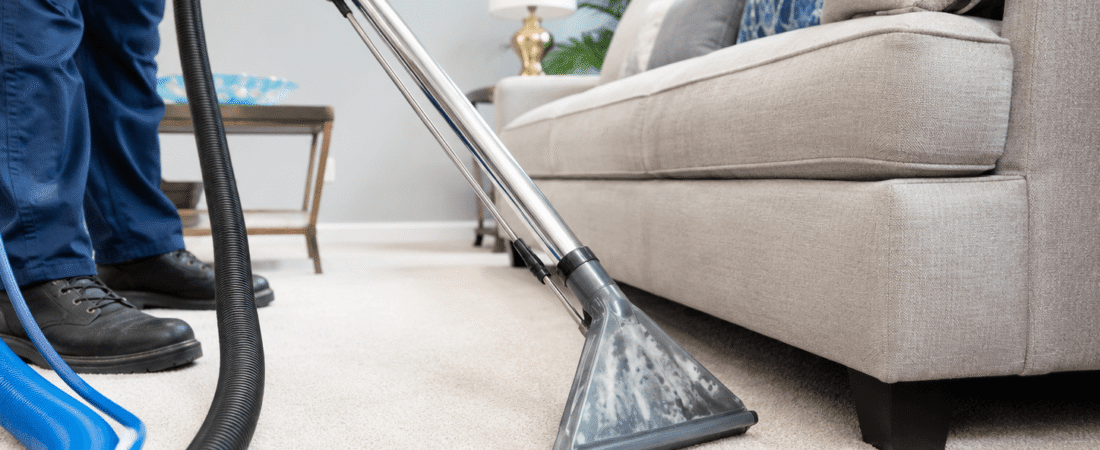
What the industry calls “steam cleaning” is hot water extraction, and it is safe on wool only when the temperature and pH are controlled for it. That means cool-to-warm water instead of the 200°F a machine can produce, a wool-rated detergent, controlled dwell time, and enough vacuum recovery that the foundation never gets soaked.
A rental machine cannot do any of that. It heats to whatever it heats to, its detergent is formulated for synthetic carpet, and its vacuum recovers a fraction of what it puts down. That combination is the single most reliable way to ruin a wool rug, and it is what most of the damaged rugs we see have been through.
Spills and pet accidents
Blot, never rub. Press straight down with a white towel and lift. Rubbing pushes the spill into the base and abrades the fibre at the same time.
Work from the outside of the spill inward so you do not spread it. Keep going with dry sections of towel until nothing more transfers.
Pet urine on wool is genuinely urgent, and the reason is chemistry rather than smell. Fresh urine is mildly acidic; as it dries it turns strongly alkaline. On a protein fibre with natural dyes, that alkalinity attacks the dye directly and leaves a permanent yellow or orange bloom — even after the odour is gone. Days matter here.
Blot as much as you can immediately, rinse with cool water, blot again, and get it treated properly. Our pet stain and odour service uses enzyme treatment that breaks down the source instead of masking it.
When to stop and call someone
Be honest about which of these applies to you. A wool rug is usually worth more than the cost of cleaning it properly.
- Anything hand-knotted, antique or oriental — value and dye risk are both high
- Any colour bleeding in the test from section 4
- Pet urine that has soaked through — the contamination is in the foundation, not the face
- Silk or viscose blends — viscose is wood pulp and turns to mush when wet. It is often sold as “art silk”
- Rugs too large to dry within 24 hours at home
- Browning after a previous cleaning attempt — treatable, but not with more water
Our area rug cleaning tests fibre and dye before any water touches the rug, uses cool water and wool-safe chemistry, and dries with controlled airflow so the foundation never sits wet.
Frequently asked questions
Can I use a carpet cleaner on a wool rug?
Only if it is explicitly labelled wool-safe and pH-neutral. Most supermarket carpet cleaners are alkaline, formulated for synthetic fibre, and will strip lanolin and cause dye to run on wool. When in doubt, do not.
Will a wool rug shrink if it gets wet?
Water alone will not shrink it. Heat plus moisture plus agitation will. That combination felts the fibre scales together, and the shrinkage is permanent. Cool water and gentle handling in the pile direction avoid it entirely.
Why did my wool rug turn brown after cleaning?
Almost always cellulosic browning. The cotton or jute foundation was over-wet, and as it dried slowly it wicked tannins up to the surface. It means too much water and too little airflow — and it is correctable by a professional.
How often should a wool rug be professionally cleaned?
Every 12 to 18 months for a rug in a living area, or annually with pets or children. Vacuum weekly in between. Regular dry soil removal does more to extend a wool rug’s life than any wash.
Do you clean wool rugs in the home or take them away?
Either, depending on the rug. Machine-made wool in good condition we clean on site. Hand-knotted, antique or urine-contaminated rugs get picked up so they can be washed and dried under controlled conditions. Call 470-590-5768 and describe the rug — or send a photo of the back, which tells us most of what we need.
Not sure what your rug is made of?
Send us a photo of the back of the rug and we will tell you the construction, the likely fibre and what it safely takes — before anything gets wet. Free estimates across Marietta and Cobb County.